A third-party subpoena can create litigation-level obligations for an organization that is not a party to the case. The safest response begins with preservation and deadline control, then narrows the requests through a defensible scope analysis before collection and production expand.
Do not assume the requesting lawyer will remind the recipient about objections, privilege, cost shifting, or confidential information. Those protections may depend on timely action.
What Is a Third-Party Subpoena?
A third-party subpoena commands a nonparty to provide testimony, documents, electronically stored information, tangible things, or access for inspection. In federal civil litigation, Federal Rule of Civil Procedure 45 governs many of the core requirements.
The issuing party must take reasonable steps to avoid imposing undue burden or expense. The court where compliance is required may quash or modify an improper subpoena and must protect a nonparty from significant expense in specified circumstances. State rules can differ, so recipients should identify the issuing court, governing rule, and place of compliance immediately.
What Should Happen on the Day of Service?
• Record the date, time, method, recipient, issuing court, case number, and compliance location.
• Send the subpoena to litigation counsel and the person responsible for legal holds.
• Calendar the production date, testimony date, and objection deadline.
• Suspend routine deletion for information reasonably implicated by the requests.
• Identify custodians, systems, vendors, archives, devices, and physical records.
• Preserve the envelope, attachments, proof of service, and later communications.
Under federal Rule 45, written objections generally must be served before the earlier of the compliance time or 14 days after service. That window can disappear while the business is still deciding who owns the response.
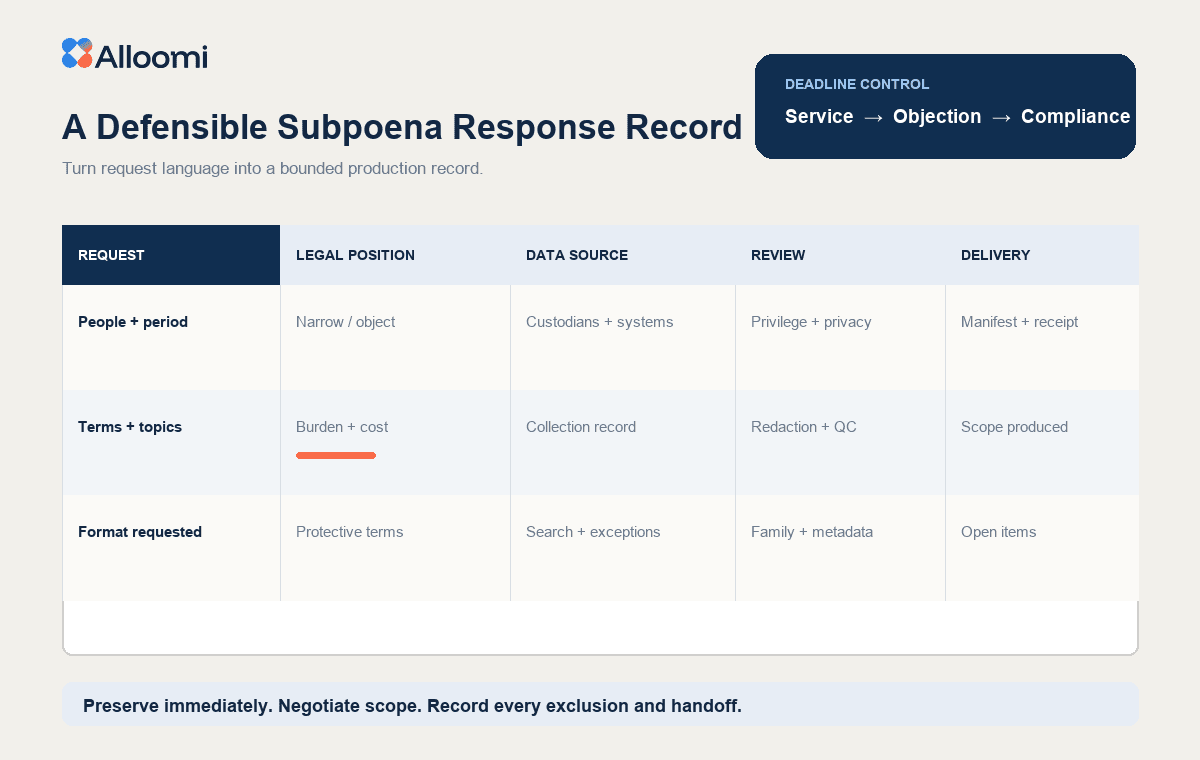
Preservation begins immediately while counsel analyzes deadlines, scope, objections, and production.
How Should Legal Teams Analyze Scope?
Translate each request into the people, date range, data source, subject, file type, and jurisdiction it actually reaches. Broad wording such as “all communications concerning” can hide multiple systems and years of data.
A response map should show which request connects to which custodian and repository. It should also identify sources that are inaccessible, duplicative, outside the recipient's possession or control, disproportionately burdensome, or likely to contain privileged or regulated information.
This mapping complements the practices described in What Is E-Discovery? and What Is a Legal Hold?.
When Should the Recipient Object or Negotiate?
Common issues include insufficient time, excessive breadth, geographic limits, undue burden, disproportionate cost, trade secrets, privacy restrictions, privilege, and requests for unavailable forms of ESI. An objection should identify the issue with enough detail to support negotiation or court review.
Negotiation can reduce custodians, date ranges, search terms, file types, or the number of requests. It can also establish phased production, cost allocation, confidentiality protection, and a process for inaccessible data. Negotiating does not automatically pause a deadline, so any extension should be confirmed in writing.
How Should Privilege and Confidentiality Be Handled?
Third-party records may include attorney-client communications, work product, personal information, health data, customer records, trade secrets, or information restricted by contract. The team should determine what may be withheld, redacted, logged, or produced under a protective order.
Privilege review should connect each withheld or redacted item to a defensible basis. See What Is Privilege Review? for the related workflow.
What Makes a Production Defensible?
A defensible production can be reconstructed. Preserve the request-to-source map, collection method, search terms, processing choices, review decisions, redactions, privilege log, load files, transmittal letter, and confirmation of delivery.
Before release, confirm that hidden metadata, comments, tracked changes, attachments, and family relationships were handled as intended. The verification controls in AI-drafted discovery responses are also useful when AI assists with summaries or issue coding.
How Alloomi Can Support a Subpoena Response
Alloomi AI can help authorized legal teams organize requests, custodians, source documents, objections, productions, and review notes while keeping conclusions connected to evidence. Human counsel must decide legal scope, privilege, objections, and what may be produced.
The practical rule is simple: preserve first, calendar immediately, narrow early, and document every decision that changes the production.
Frequently Asked Questions
1. Does a document subpoena require an in-person appearance?
Under federal Rule 45, a person commanded only to produce materials generally need not appear personally unless the subpoena also commands attendance.
2. Can a nonparty recover subpoena compliance costs?
Cost protection can be available depending on the governing rule, burden, court order, and facts. The recipient should raise significant expense early.
3. Should preservation wait until objections are resolved?
No. Reasonable preservation should begin while scope and objections are being evaluated.